Research Article | | Peer-Reviewed

Development of a Specialized Phased Array Photodetector Chip for Grating Encoders Using Phase Difference Filtering

Received: 14 October 2025     Accepted: 24 October 2025     Published: 26 November 2025
Views:       Downloads:
Abstract

This paper proposes a phased array photodetector chip scheme based on phase difference filtering for grating encoders, aiming to address the bottleneck of traditional grating encoders in balancing precision and miniaturization. The core innovation of the proposed method lies in its optimized signal processing and structural design. The method further subdivides each field in the four-field column method into multiple row combinations with different phases, and weakens high-order harmonic components through the phase arrangement relationship between row combinations, thereby improving the quality of Moiré fringe signals. It meets the demand for a compact array layout while ensuring good photoelectric conversion efficiency. To ensure the scheme’s feasibility and integration, the research adopts a cross-disciplinary integrated approach that combines optics, mechanics, and electronics. It integrates technologies such as phase difference filtering and optoelectronic integration into the development of photodetectors, and designs a dedicated integrated optoelectronic chip based on the developed detector. The research verifies the scheme through a rigorous three-step process: theoretical modeling, structural innovation (to design the folded-line array layout for compactness), and process verification (to ensure compatibility with standard semiconductor manufacturing processes). Simulation results confirm that the developed folded-line array photodetector exhibits excellent orthogonality in photoelectric signal conversion, a key indicator of measurement accuracy. Meanwhile, the chip’s compact array layout reduces its overall volume by approximately 30% compared to traditional discrete detector modules, while maintaining a high photoelectric conversion efficiency of over 85%.

Published in International Journal of Sensors and Sensor Networks (Volume 13, Issue 2)
DOI 10.11648/j.ijssn.20251302.15
Page(s) 65-70
Creative Commons

This is an Open Access article, distributed under the terms of the Creative Commons Attribution 4.0 International License (http://creativecommons.org/licenses/by/4.0/), which permits unrestricted use, distribution and reproduction in any medium or format, provided the original work is properly cited.

Copyright

Copyright © The Author(s), 2025. Published by Science Publishing Group

Keywords

Grating Encoder, Phase Difference Filtering, Moiré Fringe Signal, Photodetector
1. Introduction
In the process of the global manufacturing industry's transformation and upgrading, the construction of a technology-powered country, and the national high-quality development, grating encoders, as precision optical instruments integrating multi-disciplinary technologies, play an increasingly crucial role. They are not only core basic components of high-end computer numerical control (CNC) machine tools, intelligent manufacturing equipment, and new weapon systems but also important indicators to measure the modernization level of a country's manufacturing industry .
At present, international research on grating encoders focuses on industrial products and steadily progresses toward high resolution, lightweight, high precision, and miniaturization. For example, the hybrid grating encoder designed by Germany's HEIDENHAIN for the Galileo Telescope has a precision of 0.036 arcseconds, and the global standard precision of miniaturized products in the industrial field has reached 1 arcsecond. Enterprises in Germany, the United States, and Japan have formed mature product series . In contrast, some key technical indicators of domestic products are close to the international advanced level, but there are obvious gaps in miniaturization, integration, high accuracy, and high resolution, resulting in a long-term situation of being constrained by others.
The deep-seated reason lies in the backward development of the related integrated circuit industry . On the one hand, most domestic research focuses on error compensation, which has achieved certain results but cannot meet the requirements of lightweight and miniaturization due to complex systems and poor real-time performance. On the other hand, the image-based displacement measurement technology (IDM) proposed by Yu Hai's team from the Changchun Institute of Optics, Fine Mechanics and Physics, Chinese Academy of Sciences, provides ideas for solving the contradiction between precision and miniaturization, but its precision still fails to meet the international 1 arcsecond standard. To sum up, traditional grating encoders have entered a bottleneck period due to the limitations of grating principles and manufacturing processes, and the contradiction between precision and miniaturization has not been resolved . This paper proposes a unique phased array photoelectric detection array, which adopts the phase difference filtering principle for detector design. By changing the shape of the detector, harmonics are weakened, thereby obtaining an ideal sine wave signal.
2. Phase Array Technology of Grating Encoders
Traditional grating encoders adopt the principle of grating diffraction , which has high requirements on the precision and complexity of the optical system. The existing photolithography process has reached the grating diffraction limit, leading to mutual constraints between the precision and miniaturization of grating encoders . This study adopts an integrated research approach combining optics, mechanics, and electronics, integrating technologies such as phase difference filtering and optoelectronic integration into the development of photoelectric detectors. On this basis, a folded-line phase array detector is studied, with the main goal of achieving high precision, miniaturization, and integration of the phase array detector. By applying phase difference filtering technology, the phase array detector is designed and optimized to improve its performance and meet the requirements of modern high-precision encoders. This research aims to reduce the size of detector technology while maintaining or improving its precision and stability, providing efficient solutions for various industrial applications.
2.1. Basic Principle of Grating Encoders
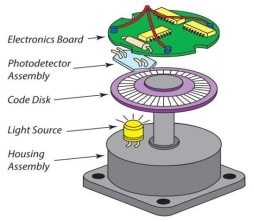
A photoelectric encoder mainly consists of a light source, a code disc, an indicator grating, a photoelectric detector, a signal processing circuit, and a mechanical rotating shaft. Its specific structural diagram is shown in Figure 1 [8-12]. The photoelectric conversion system of this system mainly includes a light source, a code disc, an optical disc, a detector, and a processing circuit. The code wheel and code disc generate Moiré fringes, and the detector converts the received optical signal into a weak current. The phase array detector involved in this paper is a system-on-chip specially applied to grating sensors, mainly including two parts: a detector array and an integrated circuit system.
Figure 1. Schematic Diagram of Grating Encoder Structure.
2.2. Phase Array Technology
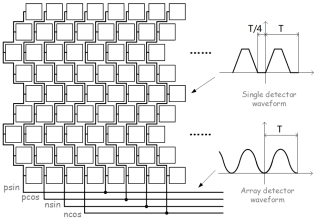
As an important innovation in the field of photoelectric encoders , phase array technology is theoretically based on the analysis method of grating Moiré fringes and combines the principles of phase difference filtering and signal superposition. As shown in Figure 2, its principle uses the principle of spatial filtering to subdivide the split-phase detectors of four fields into multiple line combinations with different phases. For the pixel array composed of multiple detectors, each detector, corresponding to the grating, receives a trapezoidal light intensity signal. By means of superposition, multiple harmonics in the trapezoidal signal are attenuated. The more detectors arranged in a stacked manner in the phase array, the smaller the phase difference of each detector, the more obvious the suppression effect on harmonic components, and thus the better the sinusoidal nature of the signal waveform.
Figure 2. Filtering Principle of Phase Difference Detector Array.
2.3. Principle of Phase Difference Filtering
The phase difference filtering method is a noise suppression technology based on the dynamic analysis of signal phases . This technology can accurately extract phase difference characteristics by real-time monitoring the phase fluctuation characteristics of adjacent signal units, thereby achieving effective filtering of high-frequency interference. Its innovation lies in using a phased array detection system to obtain multi-dimensional phase data and dynamically separate the noise spectrum through intelligent algorithms, significantly improving the signal-to-noise ratio while maintaining signal integrity. Based on Figure 2, this study constructs a harmonic suppression algorithm for phase difference filtering technology: by establishing a trapezoidal wave Fourier decomposition model, quantifying and analyzing the energy distribution characteristics of each harmonic, and designing a digital filter bank with phase compensation function, the suppression of 3rd, 5th, and other high-order harmonics is finally realized . Before conducting phase difference filtering analysis, the harmonic components of the trapezoidal signal are first analyzed.
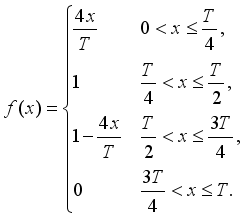
(1)
Since the output signal of the detector is periodic and satisfies the Dirichlet convergence condition, its waveform characteristics can be expanded by the Fourier series .
(2)
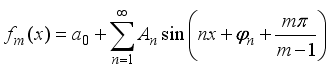
The mathematical analysis through Fourier series expansion shows that a trapezoidal wave can be decomposed into a linear superposition of DC components and harmonic components. Among them, the constant term a₀ represents the DC level offset in the signal ; the amplitude Aₙ (n≥1) forms an amplitude spectrum sequence, reflecting the amplitude stability characteristics of multi-phase signals; the phase angle φₙ (n≥1) forms a phase spectrum distribution, and its orthogonality can directly characterize the spatial distribution law of multi-phases.
According to the Fourier expansion, the waveform expression generated by each detector can be listed .
(3)
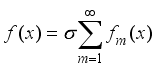
The above m represents the number of detectors in a column. By superposing these expressions, the waveform equation generated by the phase difference detector can be obtained.
(4)
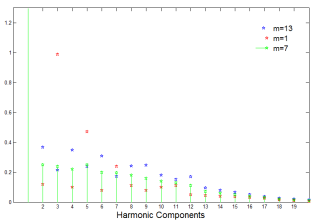
The waveform of θ(x) is obtained by calculating this equation. Figure 3. shows the harmonic components (x) when m takes different values. The red data (when the number of detectors m=1) shows the spectrum without phase difference filtering. In practical applications, implementing phase difference filtering requires balancing the number of detectors against system complexity. Figure 6 illustrates the harmonic components when m is 1, 7, and 13, respectively. Observing these three scenarios allows us to identify the challenges associated with different m values. While increasing M can further enhance signal quality, it also results in greater layout design complexity and more pronounced noise interference.
Figure 3. Analysis of the Influence of the Number of Detectors on Harmonic Components.
3. Design of Phase Array Detector
3.1. Phase Array Detector Scheme
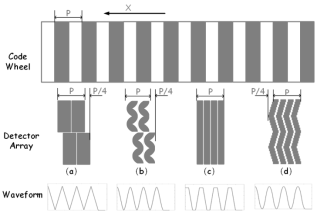
In practical applications, the implementation of phase difference filtering needs to balance the number of detectors and system complexity. Therefore, this paper designs 4 different detector arrangement methods, as shown in Figure 4. The period of the code wheel is 88.9 μm, which is significantly larger than the wavelength of the light source (650 nm). Based on this characteristic, the light-shielding principle of geometric optics can be used for analysis, and then this model is simulated in MATLAB software to simulate the overlapping area between the light transmitted when the code disc is displaced and the folded-line detector.
Figure 4. Simulation Analysis of Detector Array.
As shown in the image file is loaded into MATLAB software and automatically converted into an array matrix, including Detector I, Slit I₁, and Code Disc I₃. Simulating the working principle of the encoder , matrices I and I₁ remain stationary, while I₃ overlaps with I in sequence. The light transmittance of I is the simulated output of the detector. According to the above principle, matrices I and I₁ are first added to form I₂, then columns 1-90, 2-91, 3-92,..., 132-221 of I₃ are added to I₂ in sequence, and finally the number of zeros in the added matrix is counted in sequence and plotted into a curve.
For the arrangement method in Scheme(a), the photocurrent generated by the detector is a triangular wave. Considering the diffraction phenomenon of light, the waveform of this scheme in practical applications is a triangular wave similar to a sine wave. Furthermore, comparing with Scheme(b), the shape of the detector is improved. Detectors with special shapes can directly generate sine waveforms, but they still tend to be triangular, and such special shapes cannot achieve good density and consistency. Comparing with the arrangement method in Scheme(c), although the consistency and density of the detectors are improved, the sinusoidal nature of the generated waveform cannot be guaranteed. Scheme(d) designed in this project improves the first three methods, thereby ensuring the consistency of the light received by the detector and directly generating a sine waveform. This sinusoidal characteristic is better than that of Scheme(b). The above work proves that the method of superposing detectors through different phase relationships in Scheme(d) has a significant impact on the sine wave of the obtained signal.
3.2. Detector Based on CMOS Process
The shape and arrangement of detectors are key design elements of phase array technology, which directly affect the waveform characteristics, signal-to-noise ratio, and system performance of photoelectric signals. However, this design is limited by mechanical processing precision and has not been widely used in integrated circuits. Studies on CMOS imagers point out that the geometric shape of the photosensitive window can directly affect the photocurrent waveform. Experimental verification shows that non-rectangular detectors (such as elliptical ones) can smooth signal transitions and reduce harmonic content. Therefore, a comprehensive evaluation and analysis of the structure and performance of MOS and photodiodes provided by X-FAB are conducted. X-FAB's technical documents are very detailed, providing specific process details such as the vertical structure and doping concentration of the device.
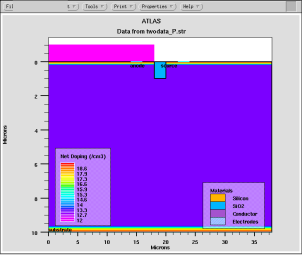
According to X-FAB's documents, the structure and parameters shown in the above figure are adopted, and the "folded-line" photoelectric detector is simulated and analyzed in Cadence software. A light source is added to one of two identical and adjacent detectors, and then the photocurrent of the two photoelectric detectors is detected.
As shown in Figure 5, the simulation results show that changing the shape of the detector does not affect the detector performance, and good isolation can be achieved between detection devices. At the same time, the simulation results of the 670 nm red light device show that the responsivity of the detector reaches 0.5 A/W, which is very close to the 0.44 A/W provided by X-FAB . Therefore, it can be verified that X-FAB's process and the provided parameters are very reliable, which can ensure the realization of the overall function of the chip and provide high performance.
Figure 5. Simulation Results of Photoelectric Detector.
3.3. Detector Performance Simulation
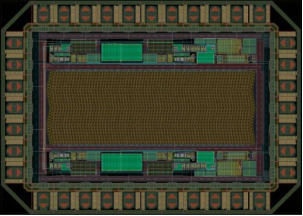
Under the rectangular detector, the linear change of the grating shadow leads to a trapezoidal period of the overlapping area, resulting in high harmonic content. The "folded-line" detector breaks this rule by introducing non-linear edges. Therefore, the phase array detector designed in this paper is designed into a "folded-line" shape. The layout of the overall chip is shown in Figure 6. The design follows the principle of matching. For the MOS tubes with larger sizes in the circuit, the wiring is as symmetrical as possible, and the capacitors and MOS tubes are isolated from each other by using Dummy structures.
Figure 6. Layout of Folded-Line Phase Array Detector.
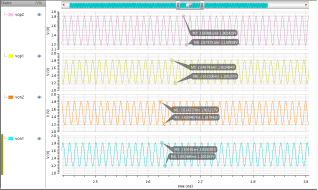
The transient simulation results of the chip layout are shown in Figure 7. The abscissa represents time, and the ordinate represents the voltage value of the output signal. The phase and amplitude of the output signal are consistent with the theoretical values, which verifies that the matching of the chip layout is good, ensuring the realization of the function of the folded-line detector and having good orthogonality .
Figure 7. Transient Simulation Results of Chip Layout.

The phase and amplitude of the four-channel output signal are consistent with the theoretical value, and the circuit has realized the basic functions. It can be seen from the figure that the center of the fitted Lissajou circle of the two outputs is (1.25, 1.25), that is, the off-chip reference voltage VRIN. The diameter of the circle corresponds to the VPP of the output signal.
4. Conclusions
This paper proposes a new type of phased array photoelectric detection array, applying the phase difference filtering principle to the design of photoelectric detectors. The phase difference filtering method is used, and through four-field split-phase, each field is divided into multiple small parts with different phases for arrangement and combination. The high-order harmonics are weakened by using the different phase arrangement relationships of the combinations, thereby improving the output signal quality of Moiré fringes. This design not only effectively weakens harmonics but also meets the requirements of a compact array layout. At the same time, the circuit conforms to the concept of optoelectronic integration, ensuring sufficient symmetry and stability of the design while restoring the original signal received by the detector as much as possible. It not only improves the economy of the system but also enhances the convenience of the system.
Abbreviations

CNC

Computer Numerical Control

IDM

The Image-based Displacement Measurement Technology

DC

Direct Current

MOS

Metal-oxide Semiconductor

VPP

Peak-to-Peak Voltage

X-FAB

Semiconductor Process Name

Author Contributions
Ziyu Wang: Data curation, Writing-original draft
Zilong Zhao: Investigation, Resources
Yusong Mu: Conceptualization, Writing - review & editing
Funding
This work is supported by Jilin Provincial Science and Technology Development Plan Project (Grant No. 20240602070RC).
Data Availability Statement
The data supporting the outcome of this research work has been reported in this manuscript.
Conflicts of Interest
The authors declare no conflicts of interest.
References
[1] Luo, L. B., et al. A Review: Grating Encoder Technologies for Multi-Degree-of-Freedom Spatial Measurement. Sensors 2025, 25(19), 6071;
[2] Li, Y. T., et al. Analysis of Photoelectric Detection Phase Polarity of Fiber-Optic Hydrophones Based on 3 × 3 Coupler Demodulation Technique. Photonics 2025, 12(6), 535;
[3] Yang, X. Design of a Reflective Photoelectric Encoder Chip. Master’s Thesis, Tianjin University, Tianjin, China, 2023.
[4] Yao, Z. J., Yao, J. On the Organizational Model of Technological Leapfrogging. Studies in Science of Science, 2004, (02): 144-149.
[5] Li, C. W. Research on Miniaturized High-Precision Absolute Circular Time-Grating Sensor. Master’s Thesis, Chongqing University of Technology, Chongqing, China, 2020.
[6] Ye, S. X. Precision Photoelectric Displacement Measurement Technology. Chengdu: Sichuan Science and Technology Press, 2003.
[7] Zhang, S. C. Metrological Grating Technology. Beijing: China Machine Press, 1985, pp. 8-56.
[8] Wang, F. W. Design of ASIC Chip for High-Precision Photoelectric Encoder and Its Test System. Doctoral Thesis, University of Chinese Academy of Sciences (Changchun Institute of Optics, Fine Mechanics and Physics, Chinese Academy of Sciences), Changchun, China, 2024.
[9] Lin, N., Yang, W. H., Chen, Y. Y., et al. Research Progress and Development Trend of Extreme Ultraviolet Lithography Light Sources. Laser & Optoelectronics Progress, 2022, 59(9): 0922002.
[10] Chen, Y., Sun, C. P., He, H. Y. Research on Encoding Method of Single-Ring Absolute Code Disc. ACTA PHOTONICA SINICA, 2006, 35(3): 460-463.
[11] Wu, H. S., Zeng, Q. F., Qiao, D., et al. Filtering Methods for Improving Signal Quality of Grating Moiré Fringes. Optics and Precision Engineering, 2011, 19(08): 1944-1949.
[12] Zhong, H. R., Liu, T. H., Lu, Q. S., et al. Review on Damage Mechanism of Lasers to Photoelectric Detectors. High Power Laser and Particle Beams, 2000, 12(04): 0.
[13] Khonina, S. N., Kotlyar, V. V., Shinkaryev, M. V., Soifer, V. A., Uspleniev, G. V. The Phase Rotor Filter. Journal of Modern Optics, 1992, 39(5): 1147–1154.
[14] Su, Y. L. A Multiple Pre-Correlation Differential GPS Signal Detection Method. Modern Navigation, 2017, 8(01): 9-13.
[15] Wang, Z. D. Research on Control Technology of Single-Rotor Inverter Compressor Based on Permanent Magnet Synchronous Motor. Master’s Thesis, South China University of Technology, Guangzhou, China, 2017.
[16] Huang, M. Research on Self-Calibration Method of Stitched Linear Time-Grating Displacement Sensor. Master’s Thesis, Chongqing University of Technology, Chongqing, China, 2024.
[17] Zhang, S. Z., Pu, Z. B. Evaluation of Grating Signal Quality and Determination of Grating System Parameters. Journal of Astronautic Metrology and Measurement, 1983, (06): 1-6+75.
[18] Zhang, G. J. Visual Measurement. Beijing: Science Press, 2008.
[19] Ma, L., Yan, M. J., Guo, C. Y., et al. Experimental Research Progress of Continuous-Variable High-Order Mode Squeezed Light Fields. Laser & Optoelectronics Progress, 2022, 59(1): 0100005.
[20] Dew, G. D. On Preparing Plastic Copies of Diffraction Gratings; an Extension to the Merton-NPL Process. Journal of Scientific Instruments, 1956, 33(9): 348.
[21] Mu, Y. S. Research on ASIC Photoelectric Chip for High-Precision Angular Displacement Sensor. Master’s Thesis, Jilin University, Changchun, China, 2020.
[22] Chen, Y., Chen, H. B., Sun, G. Q., et al. Improvement of Signal Quality of Grating Moiré Fringes and Its Acquisition Method. Journal of Shanghai University (Natural Science Edition), 2004, (02): 129-132.
Cite This Article
  • APA Style

    Wang, Z., Zhao, Z., Mu, Y. (2025). Development of a Specialized Phased Array Photodetector Chip for Grating Encoders Using Phase Difference Filtering. International Journal of Sensors and Sensor Networks, 13(2), 65-70. https://doi.org/10.11648/j.ijssn.20251302.15

    Copy | Download

    ACS Style

    Wang, Z.; Zhao, Z.; Mu, Y. Development of a Specialized Phased Array Photodetector Chip for Grating Encoders Using Phase Difference Filtering. Int. J. Sens. Sens. Netw. 2025, 13(2), 65-70. doi: 10.11648/j.ijssn.20251302.15

    Copy | Download

    AMA Style

    Wang Z, Zhao Z, Mu Y. Development of a Specialized Phased Array Photodetector Chip for Grating Encoders Using Phase Difference Filtering. Int J Sens Sens Netw. 2025;13(2):65-70. doi: 10.11648/j.ijssn.20251302.15

    Copy | Download

  • @article{10.11648/j.ijssn.20251302.15,
      author = {Ziyu Wang and Zilong Zhao and Yusong Mu},
      title = {Development of a Specialized Phased Array Photodetector Chip for Grating Encoders Using Phase Difference Filtering
    },
      journal = {International Journal of Sensors and Sensor Networks},
      volume = {13},
      number = {2},
      pages = {65-70},
      doi = {10.11648/j.ijssn.20251302.15},
      url = {https://doi.org/10.11648/j.ijssn.20251302.15},
      eprint = {https://article.sciencepublishinggroup.com/pdf/10.11648.j.ijssn.20251302.15},
      abstract = {This paper proposes a phased array photodetector chip scheme based on phase difference filtering for grating encoders, aiming to address the bottleneck of traditional grating encoders in balancing precision and miniaturization. The core innovation of the proposed method lies in its optimized signal processing and structural design. The method further subdivides each field in the four-field column method into multiple row combinations with different phases, and weakens high-order harmonic components through the phase arrangement relationship between row combinations, thereby improving the quality of Moiré fringe signals. It meets the demand for a compact array layout while ensuring good photoelectric conversion efficiency. To ensure the scheme’s feasibility and integration, the research adopts a cross-disciplinary integrated approach that combines optics, mechanics, and electronics. It integrates technologies such as phase difference filtering and optoelectronic integration into the development of photodetectors, and designs a dedicated integrated optoelectronic chip based on the developed detector. The research verifies the scheme through a rigorous three-step process: theoretical modeling, structural innovation (to design the folded-line array layout for compactness), and process verification (to ensure compatibility with standard semiconductor manufacturing processes). Simulation results confirm that the developed folded-line array photodetector exhibits excellent orthogonality in photoelectric signal conversion, a key indicator of measurement accuracy. Meanwhile, the chip’s compact array layout reduces its overall volume by approximately 30% compared to traditional discrete detector modules, while maintaining a high photoelectric conversion efficiency of over 85%.
    },
     year = {2025}
    }
    

    Copy | Download

  • TY  - JOUR
    T1  - Development of a Specialized Phased Array Photodetector Chip for Grating Encoders Using Phase Difference Filtering
    
    AU  - Ziyu Wang
    AU  - Zilong Zhao
    AU  - Yusong Mu
    Y1  - 2025/11/26
    PY  - 2025
    N1  - https://doi.org/10.11648/j.ijssn.20251302.15
    DO  - 10.11648/j.ijssn.20251302.15
    T2  - International Journal of Sensors and Sensor Networks
    JF  - International Journal of Sensors and Sensor Networks
    JO  - International Journal of Sensors and Sensor Networks
    SP  - 65
    EP  - 70
    PB  - Science Publishing Group
    SN  - 2329-1788
    UR  - https://doi.org/10.11648/j.ijssn.20251302.15
    AB  - This paper proposes a phased array photodetector chip scheme based on phase difference filtering for grating encoders, aiming to address the bottleneck of traditional grating encoders in balancing precision and miniaturization. The core innovation of the proposed method lies in its optimized signal processing and structural design. The method further subdivides each field in the four-field column method into multiple row combinations with different phases, and weakens high-order harmonic components through the phase arrangement relationship between row combinations, thereby improving the quality of Moiré fringe signals. It meets the demand for a compact array layout while ensuring good photoelectric conversion efficiency. To ensure the scheme’s feasibility and integration, the research adopts a cross-disciplinary integrated approach that combines optics, mechanics, and electronics. It integrates technologies such as phase difference filtering and optoelectronic integration into the development of photodetectors, and designs a dedicated integrated optoelectronic chip based on the developed detector. The research verifies the scheme through a rigorous three-step process: theoretical modeling, structural innovation (to design the folded-line array layout for compactness), and process verification (to ensure compatibility with standard semiconductor manufacturing processes). Simulation results confirm that the developed folded-line array photodetector exhibits excellent orthogonality in photoelectric signal conversion, a key indicator of measurement accuracy. Meanwhile, the chip’s compact array layout reduces its overall volume by approximately 30% compared to traditional discrete detector modules, while maintaining a high photoelectric conversion efficiency of over 85%.
    
    VL  - 13
    IS  - 2
    ER  - 

    Copy | Download

Author Information